by Trish Fotheringham
Learn About Dissociation
- Why Does Dissociation Matter?
- What is Dissociation?
- What can be Dissociated?
- How Needs, Communication and Beliefs Impact Dissociation
- The Spectrum of Dissociative Effects
- What is Dissociative Identity?
- Healthy Perspectives and Approaches
- Dissociation-related Definitions
Looking For Support?
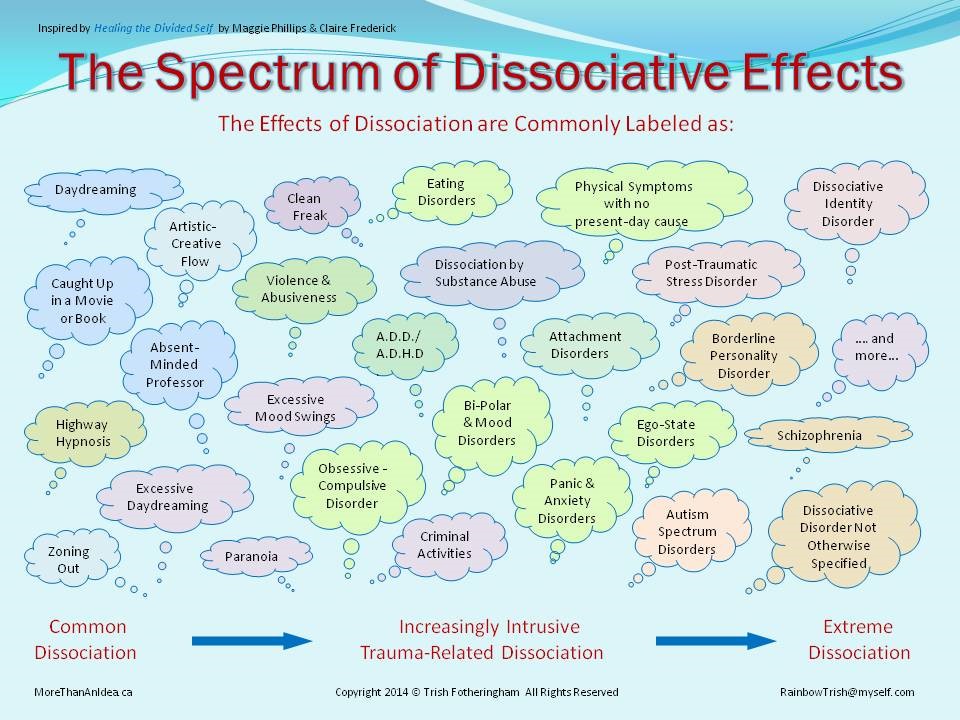
The Spectrum of Dissociative Effects
The Spectrum of Dissociation touches all of us in some manner, impacting and influencing us, our choices and decisions, activities and behaviors, to a greater degree than most of us realize, and certainly far more than is currently recognized or acknowledged within the mainstream systems and structures that are most affected by the Effects of Dissociation.
Civilization requires and creates Dissociation.
Originally, everything was Oneness, the connectedness of All That Is. Humans lived the tribal hunter/gatherer life, as part of a larger natural order and cycle of life, in tune with the sun, moon, seasons, mating, community, etc. Dissociation served its original purpose, kept us safe, sane, and able to function sufficiently to enable survival.
However, as people moved from tribal life into villages, then from towns to cities, individuals had to dissociate the stuff of normal daily life to survive and continue to belong within the framework of the larger group. Living in close proximity to others meant sharing safety, but also other often unbearable things such as body and waste smells, and the noise of neighbors emotional outbursts, arguments, and sexual activity. Nature’s antidote was the common, helpful version of Dissociation – just like when we enter a room with an unbearable stench and within a few minutes we “get used to it”, or when we are sitting at a restaurant table and the noise of nearby tables fades out so we can hear the conversation at our table.
This move to communal living also meant that individual needs naturally began to have less importance as each culture/society created customs, rules and laws to ensure the group’s needs were met. As a result, our Societal rules and norms, past and present, ordinary to extreme, have been shaped and formed with Dissociation woven in at all levels. Dissociation is now built into the foundations of how society functions and dysfunctions, and it is common for dissociation-related issues that arise in our personal lives to be misunderstood, misdiagnosed and mistreated by the people and systems that deal with them. This is particularly evident in the realms of poverty, mental health and criminal justice. Even the larger arenas of governments, systems, institutions, corporations and such have their own versions of Dissociation at work, enabling money, power and profit to matter more than the needs of people, animals, plants, and the environment.
The Dissociative Spectrum is an informative and empowering framework for seeing and interpreting the world
The Dissociative Spectrum gives us a means of recognizing and categorizing the various individual and societal Dissociative influences and impacts that afflict humanity. From the personal to the group and collective level, this information and understanding gives us a powerful tool for positive change.
For example, Trauma-Related Difficulties are Commonly Misdiagnosed as:
- Addiction-Related Difficulties
- Adjustment Disorders
- Anxiety and Panic Disorders
- Attention Deficit/Hyperactive Disorders
- Bodily (Somatic) Disorders
- Criminal Intent/Action
- Depression
- Eating Disorders
- Fetal Alcohol Effect
- Learning Disabilities
- Mood (Affective) Disorders
- Obsessive Compulsive Disorders
- Personality Disorders
- Psychopathic/Sociopathic/Evil
- Schizophrenia
- and more…
All of these diagnoses and more can fall within the explanatory framework of the Spectrum of Dissociation. My interpretation of how it all fits together was in large part inspired by a chart in the book “Healing the Divided Self” by Maggie Phillips and Claire Frederick. My version is more broad and all-encompassing in scope than theirs. I have adapted their chart accordingly, adding some of the disorders that I am convinced belong on the spectrum, but which have not yet been acknowledged (and may have even been intentionally repressed!) by the traditional systems, and academic institutions and professions, such as psychiatric, mental health, “big pharma”, criminal justice, financial and corporate, etc.
My interpretation of the Spectrum of Dissociation looks like this:
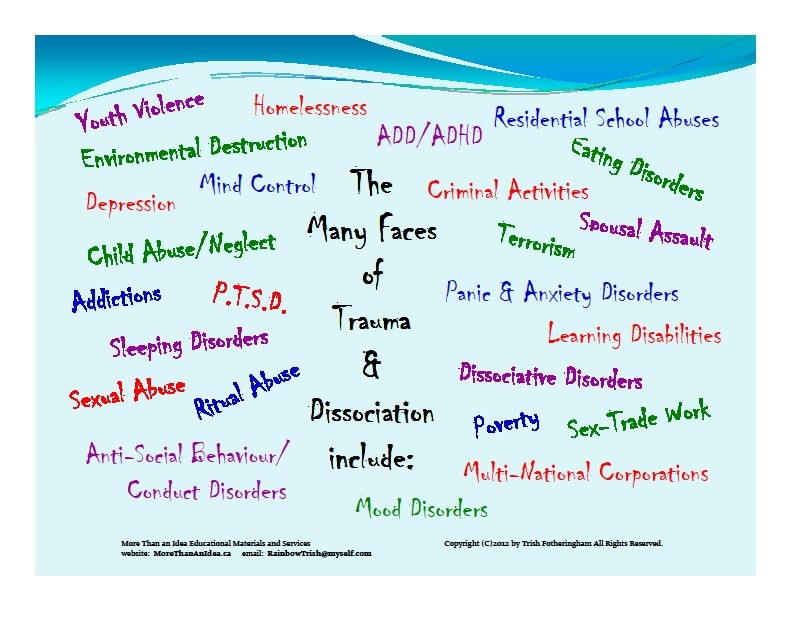
The Effects of Dissociation are the Effects of the Trauma that caused the Dissociation. I think of these effects as the Many Faces of Trauma and Dissociation:
Understanding Dissociation and the Dissociative Spectrum Produces Many Benefits!
As becomes obvious when we learn even just a little about it, Dissociation is commonly at the root of our individual and societal ills, and as such, is of great importance to all of us.
Applying understanding of Dissociation and the Dissociative Spectrum and allowing it to permeate through all areas of our lives and societal systems and structures cannot help but benefit every one of us, as well as all other life on earth and even the planet itself. All we need do is allow it to take root, grow, and spread through our lives and world!
What is Dissociative Identity?
Dissociative Identity Disorder (D.I.D.) is the psychiatric label for the natural survival response people default to when they are subjected to repeated unbearable trauma.
This term does not accurately describe the phenomenon of Dissociative Identity.
Dissociation is a normal human response that protects a person’s mind, body and spirit. Instead of the misleading and inaccurate label Dissociative Identity Disorder, Dissociative Identity Response (D.I.R.) is the more apt term survivors are now using to describe the broader truth of this valuable and clever human ability.
Dissociative Identity Response is mistakenly named a disorder in part due to how, after its helpful purpose ends, Dissociation that remains unprocessed can cause a broad range of unwanted intrusions and interferences in our lives. (See my Spectrum of Dissociative Effects section.)
Dissociative Identity Response goes beyond dissociating some aspects of a traumatic experience into dissociating all aspects of an experience (or series of experiences) into a container that needs an identity, sense of self, or separate personality to hold and cope with the fullness and depth of the impact of repeated trauma.
For example, a young child repeatedly sexually abused by the neighbor down the street who everybody loves may need to completely partition away the part/s of self that must endure the ongoing traumatic experiences, so that the part of the child that must be around the “nice neighbor” can stay safe and not know/need to tell the “nasty neighbor secrets”. This means that without the child’s conscious awareness, he/she must create a container self to hold the “nasty neighbor” traumas and adapt the “usual self” to interact with the “nice neighbor” at neighborhood BBQs and such. So, the “usual self” can interact with Mr. Nice while removed from all awareness of the personality/dissociated identity created to endure Mr. Nasty.
Now imagine this same child is later sexually abused by a teacher at school and also continually shamed and humiliated by a sports coach, both of whom are well-liked and respected authority figures. Since the child’s natural survival response already learned how to segregate experiences to endure the unbearable, new dissociated identities are naturally and readily created for the new traumas and abusers.
Dissociative Identity Manifests Differently for Each Individual
Just as every person is different and experiences, thinks, feels, responds and remembers in their own unique ways, Dissociative Identity Response manifests in ways distinctly unique to each individual.
As a result, how a person dissociatively contains their experiences cannot be predicted, and any dissociated identities one person may have will be at most only similar to another person’s dissociated identities. Therefore, any label or treatment must incorporate this understanding to produce accurate definitions and fully effective healing results.
 BY OURSELVES | ABOUT OURSELVES | FOR OURSELVES | FOR EACH OTHER |