
Trish Fotheringham (1960-2020) was a mind control survivor and activist. Her passion was spreading understanding, hope, and inspiration by educating people about the powerful tool of Understanding Dissociation and the Spectrum of Dissociative Effects.
It’s as if understanding of the basics of dissociation creates an echo in people’s minds that bounces around until, like a seed, it takes root in even the most barren and harsh conditions, thereafter growing and evolving in ways that inevitably produce life-enhancing results. This consistent positive effect awes and delights me at the same time it proves to me the power of simple understanding! – Trish Fotheringham
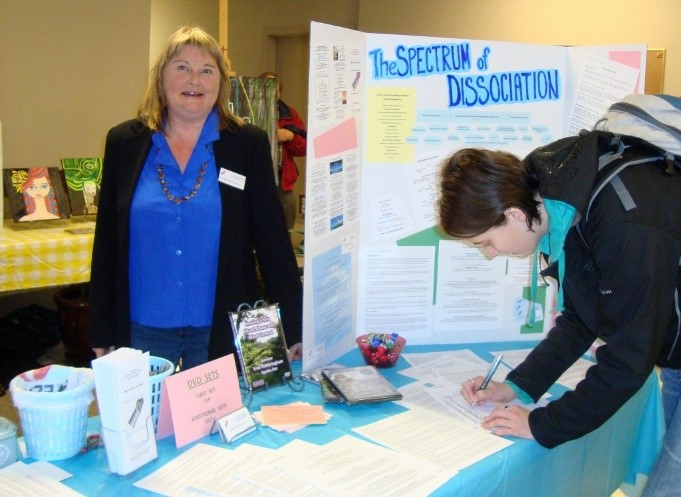
Although Trish’s website no longer exists, in honor of Trish and her activism, we are sharing her information on Dissociation and the Spectrum of Dissociative Effects here so she can continue to spread her message of love and understanding.
Learn About Dissociation
- Why Does Dissociation Matter?
- What is Dissociation?
- What can be Dissociated?
- How Needs, Communication and Beliefs Impact Dissociation
- The Spectrum of Dissociative Effects
- What is Dissociative Identity?
- Healthy Perspectives and Approaches
- Dissociation-related Definitions
Looking for support?
Why Does Dissociation Matter?
Understanding Dissociation gives us the power to transform our lives and our world!
We all use Dissociation in our daily lives, mostly instinctively and unconsciously. Dissociation is an ordinary coping mechanism, a natural, built-in survival response to the unbearable or traumatic. It involves core levels of our needs and beliefs, so understanding it can help us make sense of what we do and why we do it.
In turn, this understanding brings to light important truths that apply to a vast array of human challenges, conditions and dysfunctions, and it also reveals how people can harm themselves, other beings, and the environment, both individually and globally. This understanding can help you create shifts and changes from the small to the seemingly impossible.
Individually:
When you understand Dissociation, and see how it manifests in your life, you have a powerful tool to transform the areas of your life that aren’t working for you.
How would your life be different if you felt more empowered and fulfilled, and knew you could create positive change in your life and the world?
- Personal Relationships: Once you understand your own actions and responses, and gain insight into the actions and responses of others, you can create better relationships with yourself, your loved ones, the people you work with, and anyone else you encounter during your day.
- Community Building: When you connect more deeply with yourself, you also form deeper connections with others. Prejudice, hate, and fear fade as we realize we share the same basic needs and drives. When we have new understandings, we can focus on these commonalities and find solutions together, choosing new ways to survive and meet our needs.
- Global Responsibility: As you come to understand dissociation, the knowledge takes root in your unconscious/subconscious. Over time, this knowledge leads to new insights and perspectives that bring to light new options, and better solutions. In turn, this enables you to make wiser choices in all areas of your life, and helps you more readily co-create a happier, sustainable world where everyone thrives.
Societally/Globally:
- Dissociation profoundly impacts the way we relate to each other and the world around us, because it occurs within every level of society, not only on an individual basis, but also within our systems, structures, institutions, corporations, etc.
- Understanding Dissociation creates a practical framework for interpreting, diagnosing, and developing new, more effective and humane treatments and approaches for everything from abuse, addictions, poverty and crime, through to environmental destruction and corporate takeovers.
- On a global level, it can be applied to politics, wars, government accountability; and corporate practices that cause environmental degradation. It can be used to create more enlightened education in institutions and other forms of study and learning.
- In the psychiatric world, when symptoms and labels are looked at as part of the Dissociative Spectrum, true healing and rehabilitation become viable and achievable in most cases, possibly even all. This is also true for addictions, criminal behaviors, and many more conditions we think of as incurable!
By consciously applying an Understanding of Dissociation, we create connection and help foster re-association of what has been dissociated, producing amazing improvements in our own and other people’s lives. The negative effects, interferences and intrusions of Dissociation that control our lives, societal rules and norms, and so-called unsolvable problems are vast. However, I believe the possibilities for positive effects and results are greater.
Understanding Dissociation makes the untreatable treatable, the unhealable healable, the unchangeable changeable!
What is Dissociation?
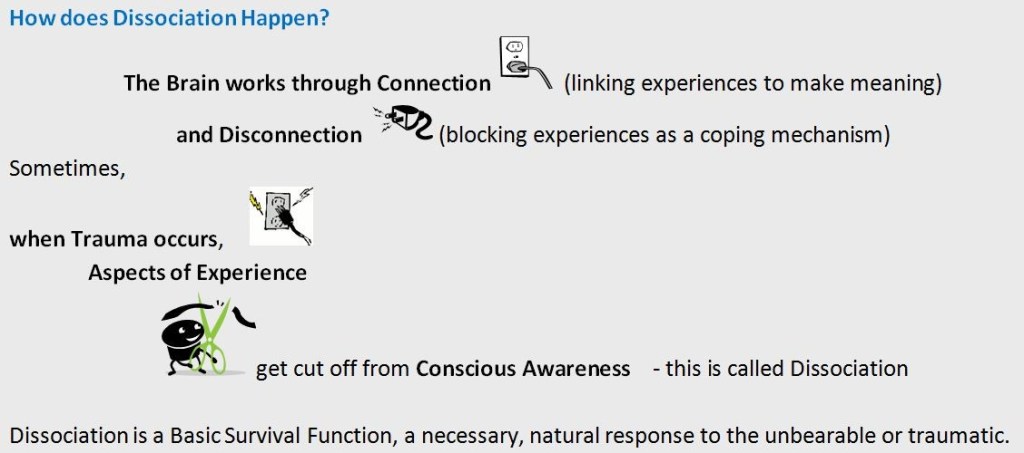
Dissociation is both an everyday, necessary coping mechanism, and a natural, built-in survival response to unbearable or traumatic events that exists to protect us and make our lives better.
However, Dissociative Responses and Effects can also interfere with and complicate our lives in ways that do not serve our best interests, and which prevent us from living in ways that we find fulfilling, joyful, and meaningful.
- Helpful Dissociation protects us, enables us to function during a crisis, and allows us to forget trauma.
- Harmful Dissociation disconnects us from unresolved pain, trauma, secrets and other aspects of life that we find unbearable. When not recognized, understood, and healed, Dissociated experiences and feelings can be toxic emotionally and spiritually, spilling out in ways that hurt us or otherwise disrupt our lives, as well as making us over-reactive, uncontrollable, and potentially harmful to ourselves and others. Every day examples include: going on an eating binge to control emotions; taking out frustrations on your child; denying being angry at someone, then expressing your anger through snide comments that affect the relationship; or even dumping trash by a river instead of properly disposing of it.
Dissociative Survival Function:
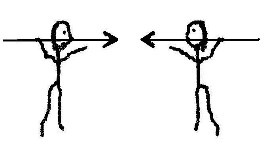
Fight
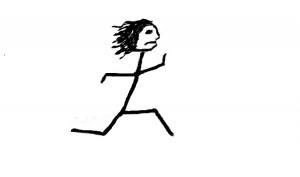
Flight

Freeze (“play dead”) = disconnect = dissociate
Most of us are familiar with the Fight or Flight Response, and how it is an instinctive survival function of humans and many other life forms. There’s also a third response – the Freeze Response. Like animals, when you can’t fight and you can’t run, you freeze.
Beyond the physical paralysis of the freeze response described above, humans can freeze individual aspects of the traumatic and/or life-threatening experience. A warrior being oblivious to battle wounds until safety is reached, or someone forgetting the moments during and before a bad car accident are common forms of our freeze response.
This human freeze response is highly evolved – just as when our can body freezes in position, our heart and mind may also freeze by locking away aspects of the traumatic experience – whatever part severely threatens our sense of safety or well-being. Sometimes, the entire memory of the experience is unbearable, causing it to be disconnected completely from our conscious awareness. Other times, only certain details like sights, sounds, or smells are disconnected. This human form of the freeze/disconnect response is what is most commonly meant by the term Dissociation.
When a person freezes by locking away aspects of an experience, memory functions differently. Like a photo or a movie paused in freeze-frame, details are frozen in place, exactly as they were at the moment the freeze occurred. The disconnected/locked away memories can actually retain all the details involved in the dissociated experience – smells, emotional content, physical sensations, sounds, etc.
Dissociation happens at a core survival level and is different from a state of extreme denial. Denial is within the scope of our conscious awareness. Dissociation, however, like breathing, is a deeper imperative. Whether in its’ everyday form or as a response to extreme trauma, dissociation is physically processed in our brains differently than denial. Basically, a memory we are in denial about will be stored fairly close to the surface, while a memory we have dissociated will be locked away in our sub-conscious.
What Can Be Dissociated?
The parts and pieces contained in your experiences are called Aspects of Experience. You can dissociate one or more Aspects of any given experience. Every experience is different with a different combination of Aspects that can be dissociated.

Aspects of Experience fall within a framework of 5 categories (based on the BASK model developed by Bennett Braun). Each category involves a grouping of specific Aspects of Experience, any of which may or may not be present in individual experiences.
- Behaviour: what you do, what you say, habits, routines, activities, coping mechanisms, etc.
- Emotions (Affect): Empathy, guilt, shame, love, hope, joy, fear, anger, sadness, etc.
- Sensations and Sensory Input: balance, sight, hearing, taste, smell touch/body feelings – temperature control, pain, comfort/discomfort, arousal, etc.
- Knowledge and Awareness: conscious memory, knowledge/information, sense of time and place, beliefs, etc.
- Identity: sense of self, personality traits, gender, age, etc.
Why Do Aspects of Experience Matter?
When an Aspect of Experience is cut-off from our conscious awareness through dissociation, it can produce effects from the mildest that has no impact on your life, through to extremes of vast and/or intense disruptions, interferences, and intrusions in life.
How can you know what effects dissociation is having in your life and that of others?
The phrases we use are clues!
Though we may not realize it, in our everyday lives we often hear and use words and phrases that convey common dissociative experiences. Recognizing the clues within these commonly used Dissociative Phrases improves our ability to understand ourselves and others, and the role that dissociation plays in all of our lives.
Familiar Phrases of Dissociation
Familiar phrases can convey the impact of dissociation in ordinary, everyday life.
| Behavior | “I couldn’t make myself do it, no matter how hard I tried.” |
| “I startle at the drop of a hat.” | |
| “I couldn’t move a muscle.” | |
| “When I’m nervous I tap my foot without noticing.” (or twist my hair) | |
| Emotions (Affect) | “Grief doesn’t get me – I’m fine.” |
| “She smiles when she tells you of her pain.” | |
| “I can’t cry.” | |
| “I never get angry.” | |
| Sensations | “I never feel the cold.” |
| “I just ignore the pain.” | |
| “The smell took me back in time.” | |
| “I feel nothing during sex.” | |
| Knowledge and Awareness | “I don’t remember my childhood.” |
| “I was in denial.” | |
| “I zoned out.” | |
| “Suddenly, it all came back to me.” | |
| “I couldn’t see it when it was right there in front of me.” | |
| Identity | “For the first time, I connected to my inner child.” |
| “I wasn’t myself.” | |
| “My life feels like it belongs to someone else.” |
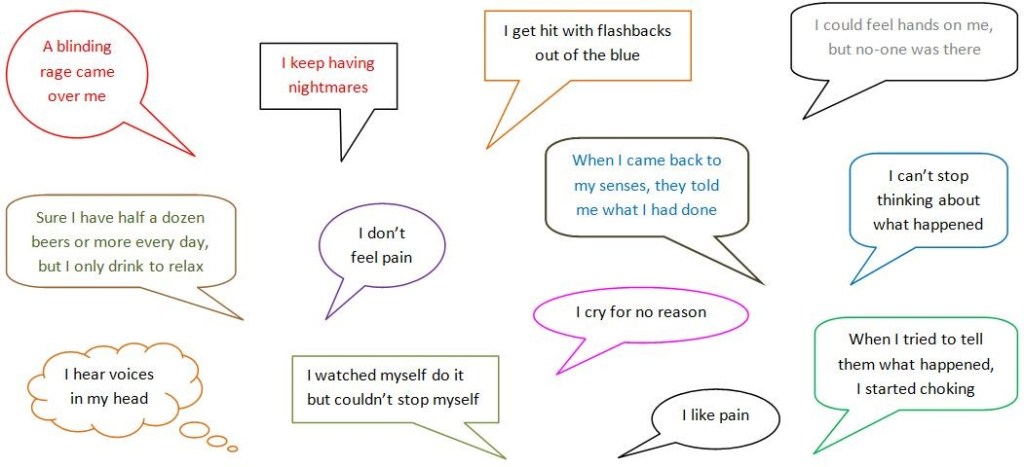
Phrases of “Moderate to Extreme Dissociation”
Some phrases can indicate the possibility of complex degrees of Dissociation of the various Aspects of a Traumatic Experience.
When a trauma-related Aspect of Experience is cut-off from our conscious awareness through dissociation, and not later healed from, it can produce a wide range of negative effects that disrupt and interfere with life. Moderate to Extreme effects of trauma and dissociation can take form as vast and/or intense disruptions, interferences, and intrusions in life. They can involve anything from flashbacks, addiction, mental health issues, or physical disability, through to violence, uncontrollable, dangerous, and/or criminal behavior, or disorders like anorexia or clinical depression, as well as many other behavioral, emotional, mental/psychiatric, or physical disorders. The phrases people use can give us clues to trauma-related dissociative effects they may be experiencing.
 BY OURSELVES | ABOUT OURSELVES | FOR OURSELVES | FOR EACH OTHER |